

 It's not just about strength. It's about balance, coordination and knowing when to let go.
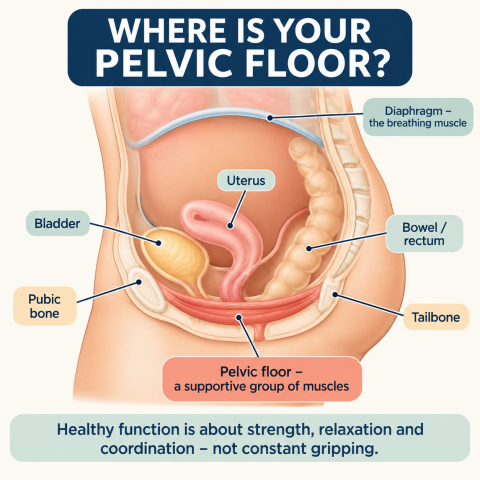
Following my recent surgery, I've found myself going down a bit of a rabbit hole exploring the pelvic floor. The more I learn, the more fascinating I find it. It's such an important part of our anatomy, yet one we rarely think about until something isn't quite right. For women particularly, it's a complex area influenced by pregnancy, childbirth, hormonal changes, menopause, ageing and surgery. The pelvic floor is a group of muscles and connective tissues forming the base of our pelvis. It supports our bladder, bowel and uterus, helps control bladder and bowel function, and contributes to sexual health and core stability. But it doesn't work alone.
The diaphragm connection
One of the most interesting relationships is between the pelvic floor and diaphragm. Think of the diaphragm as the roof of our abdominal cavity and the pelvic floor as the floor. When we breathe in, the diaphragm moves downwards and the pelvic floor generally lengthens with it. As we breathe out, both move upwards again. Together with the abdominal and deeper back muscles, they help manage pressure when we breathe, lift, cough, exercise and move.
The fascia connection
The pelvic floor is also part of a much bigger connective tissue network. Fascia surrounds and supports muscles, organs and other structures, helping connect different areas of the body. Within the pelvis, these tissues support the pelvic organs and interact with surrounding structures, including the abdominal wall and hips. It's a good reminder that pelvic floor health isn't just about the pelvis itself. How we breathe, move and manage pressure throughout the body matters too.
Can a pelvic floor be both weak and tight?
Absolutely. This is one of the biggest misconceptions about pelvic floor health. A muscle can be overactive and constantly gripping, yet still lack the ability to contract effectively when needed. A tight pelvic floor can struggle to relax and lengthen, potentially contributing to pelvic pain, urinary urgency, constipation and discomfort during intercourse. At the other end, a pelvic floor that lacks sufficient strength or support may contribute to urinary leakage, pelvic heaviness and prolapse symptoms. Both can involve weakness, but for very different reasons.
Finding the Goldilocks zone
The goal isn't a pelvic floor that's constantly switched on, or one that's too relaxed to provide support. We want muscles that can contract when needed, relax when appropriate, lengthen with breathing and movement, and coordinate with the diaphragm and core. Sometimes this means strengthening. Sometimes it means learning to release and relax. Often, it's a combination of both.
How can osteopathy help?
Osteopathy takes a whole-body approach, looking at how the pelvic floor works with the diaphragm, abdominal wall, hips and lower back. Treatment may include gentle hands-on techniques, improving mobility, addressing tension and exploring breathing and movement patterns to support better coordination and function.
My recent experience has made me appreciate just how central the pelvic floor is to our overall wellbeing. It's not simply a group of muscles at the bottom of our pelvis. It's an important part of a much bigger system. Good pelvic floor function isn't about holding everything tight. It's about having the strength, flexibility and coordination to support us through life.
By Monica Bruce